Willkommen!

Das Leibniz-Institut für Astrophysik Potsdam (AIP) widmet sich astrophysikalischen Fragen, die von der Untersuchung unserer Sonne bis zur Entwicklung des Kosmos reichen. Seine Schwerpunkte liegen in der Erforschung der Sternphysik, Sonnenphysik und Exoplaneten, in der extragalaktischen Astrophysik sowie in der Entwicklung von Forschungstechnologien in den Bereichen Spektroskopie, robotische Teleskope und E-Science.

_DSC8238_V01a
ELT
hifiplus_mosaic_Teaser
Sun-magnetic_field_lines
MUSE Ultra Deep Field

Dr. Joseph Whittingham erhält den Preis der Physikalischen Gesellschaft zu Berlin e.V. für seine Doktorarbeit, die er unter der Betreuung von Prof. Dr. Christoph Pfrommer am Leibniz-Institut für Astrophysik Potsdam (AIP) sowie an der Universität Potsdam anfertigte.

[mehr]

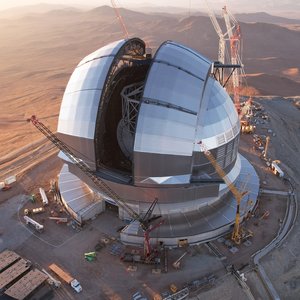
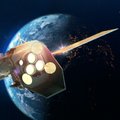
Die ESO hat heute ein Übereinkommen mit einem internationalem Großkonsortium über die Entwicklung und den Bau des Multi-Object Spectrograph (MOSAIC) unterzeichnet, einem Instrument für das Extremely Large Telescope (ELT) der ESO. Am zukünftig größten optischen Teleskop der Welt wird MOSAIC das Licht von hunderten astronomischen Quellen gleichzeitig messen und damit das Wachstum von Galaxien und die Verteilung von Materie vom Urknall bis zur Gegenwart verfolgen. Als Mitglied des Konsortiums ist das AIP für die technische Entwicklung von MOSAIC, sowie für die Vorbereitung seiner wissenschaftlichen Nutzung mit verantwortlich.

[mehr]

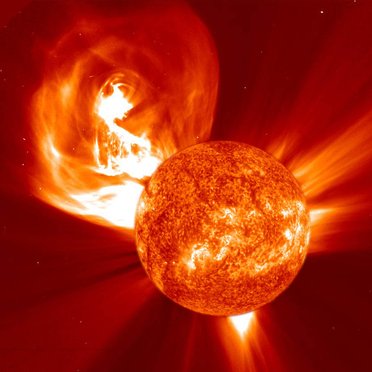
Ein seltenes, hochauflösendes Bild einer Sonnenfleckengruppe, in der sich zwei starke Sonneneruptionen der Klasse X ereigneten, ist Wissenschaftlerinnen und Wissenschaftlern kürzlich gelungen – eine Beobachtung, die von der Erde aus nur selten möglich ist. Mit dem GREGOR-Sonnenteleskop auf Teneriffa haben die Forschenden die explosive Aktivität der energiereichsten Sonnenfleckengruppe des Jahres 2025 aufgezeichnet und dabei verwirbelte Magnetfeldstrukturen und die frühen Stadien der Entstehung von Sonneneruptionen mit bisher unerreichter Detailgenauigkeit sichtbar gemacht.

[mehr]

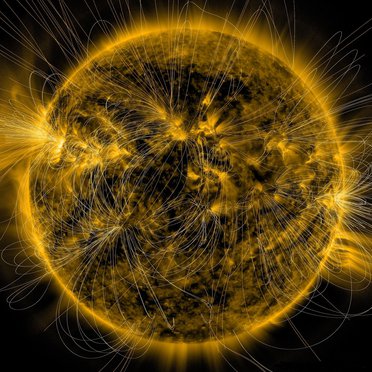
Das kosmische Geschehen wird von zwei Naturkräften bestimmt: der Gravitation und den Magnetfeldern. Die Magnetfeld-Forschungen am AIP konzentrieren sich im Wesentlichen auf Fragestellungen der magnetohydrodynamischen (MHD) Simulationsrechnung, der magnetisch bedingten Aktivitäten auf der Sonne und den Sternen, der solaren Koronaphysik sowie des Weltraumwetters in unserem Sonnensystem und bei Planeten um andere Sterne.

[mehr]

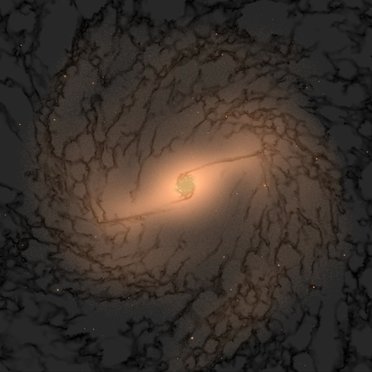
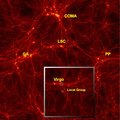
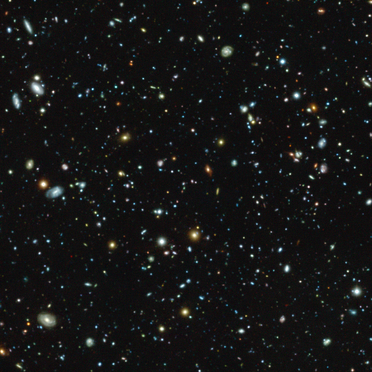
Galaxien sind grundlegende Bausteine des Kosmos. Auf den größten Skalen dienen sie als Marker, um die Verteilung der Materie im Universum zu untersuchen - aktive Galaxien und Quasare sind aufgrund ihrer intrinsischen Helligkeit besonders wichtig. Nahe Objekte lassen sich räumlich auflösen und bestehen aus Populationen mit sehr unterschiedlichen Bewegungsmustern, Sternentstehungsgeschichten und chemischen Häufigkeiten.

[mehr]

Im Rahmen einer Sonderveranstaltung des „Potsdamer Lesesalons“ und dem Leibniz-Institut für Astrophysik Potsdam (AIP) öffnet das AIP am Donnerstag, den 11.12.2025 seine Türen für eine ganz besondere Veranstaltung. Unter dem Titel „Galaxien und Weltraumkatzen – Sternennacht zwischen Science und Fiktion“ laden der Potsdamer Schriftsteller Tobias Radloff und Dr. Ramona Augustin vom AIP zu einer interdisziplinären Expedition ins All.

Dr. Joseph Whittingham erhält den Preis der Physikalischen Gesellschaft zu Berlin e.V. für seine Doktorarbeit, die er unter der Betreuung von Prof. Dr. Christoph Pfrommer am Leibniz-Institut für Astrophysik Potsdam (AIP) sowie an der Universität Potsdam anfertigte.

Die Europäische Südsternwarte ESO hat heute ein Übereinkommen mit einem internationalem Großkonsortium über die Entwicklung und den Bau des Multi-Object Spectrograph (MOSAIC) unterzeichnet, einem Instrument für das Extremely Large Telescope (ELT) der ESO. Am zukünftig größten optischen Teleskop der Welt wird MOSAIC das Licht von hunderten astronomischen Quellen gleichzeitig messen und damit das Wachstum von Galaxien und die Verteilung von Materie vom Urknall bis zur Gegenwart verfolgen. Als Mitglied des Konsortiums ist das Leibniz-Institut für Astrophysik Potsdam (AIP) für die technische Entwicklung von MOSAIC, sowie für die Vorbereitung seiner wissenschaftlichen Nutzung mit verantwortlich.


Aktuelle Publikationen

The THESAN-ZOOM project: star formation efficiency from giant molecular clouds to galactic scale in high-redshift starbursts

Wang, Z., ... Puchwein, E., ...
Monthly Notices of the Royal Astronomical Society, 544, 3, 2675 – Veröffentlicht Dezember 2025

Ultra-diffuse, ultra-different: observed versus simulated ultra-diffuse galaxies live in fundamentally different haloes

Gannon, J. S., ... Libeskind, N., ...
Monthly Notices of the Royal Astronomical Society, 544, 4, 3094 – Veröffentlicht Dezember 2025

The THESAN-ZOOM project: central starbursts and inside-out quenching govern galaxy sizes in the early Universe

McClymont, W., ... Puchwein, E., ...
Monthly Notices of the Royal Astronomical Society, 544, 2, 1732 – Veröffentlicht Dezember 2025

Applying a star formation model calibrated on high-resolution interstellar medium simulations to cosmological simulations of galaxy formation

Burger, J. D., ... Weinberger, R.
Monthly Notices of the Royal Astronomical Society, 544, 2, 1390 – Veröffentlicht Dezember 2025

Quadrupole signature as a kinematic diagnostic to constrain bar properties: Implications for the Milky Way

Ghosh, S., ... Khoperskov, S., ...
Astronomy and Astrophysics, 704, A11 – Veröffentlicht November 2025

Surface activity of a Rossby sequence of cool Hyades stars

Strassmeier, K. G., Ilyin, I., Steffen, M., Barnes, S. A.
Astronomy and Astrophysics, 704, A8 – Veröffentlicht November 2025

Overmassive black holes in the early Universe can be explained by gas-rich, dark matter-dominated galaxies

McClymont, W., ... Puchwein, E., ...
Monthly Notices of the Royal Astronomical Society – Veröffentlicht November 2025

MUSEQuBES: The Column Density, Covering Fraction, Mass, and Environmental Dependence of Cool H I Gas Around Low-Redshift Galaxies

Dutta, S., ... Augustin, R., ...
Monthly Notices of the Royal Astronomical Society – Veröffentlicht November 2025

Early Coformation of the Milky Way's Thin and Thick Disks at Redshift z > 2

Borbolato, L., ... Chiappini, C., ...
The Astrophysical Journal, 994, 1, 126 – Veröffentlicht November 2025

MOGLI: Model for Multiphase Gas using Multifluid hydrodynamics

Das, H. K., Gronke, M., Weinberger, R.
Monthly Notices of the Royal Astronomical Society – Veröffentlicht November 2025

Serendipitous Discovery of a Faint Planetary Nebula in the Massive Young LMC Cluster NGC 1866

Bond, H. E., ... Niederhofer, F., Roth, M. M., Soemitro, A. A.
Publications of the Astronomical Society of the Pacific, 137, 11, 114202 – Veröffentlicht November 2025

The large-scale kinematics of young stars in the Milky Way disc: First results from SDSS-V

Zari, E., ... Khoperskov, S., ...
Astronomy and Astrophysics, 703, A303 – Veröffentlicht November 2025

The odd primordial halo of the Milky Way implied by Gaia: A shallow core, but a steep decline

Li, P., McGaugh, S. S., Pawlowski, M. S., Hammer, F., Sellwood, J. A.
Astronomy and Astrophysics, 703, L17 – Veröffentlicht November 2025

The effects of the environment on the central activity of galaxies as derived using mid-IR tracers

Morales-Vargas, A., ... Salas, H.
Astronomy and Astrophysics, 703, A300 – Veröffentlicht November 2025

Source location and evolution of a multilane type II radio burst

Zucca, P., ... Vocks, C.
Astronomy and Astrophysics, 703, A271 – Veröffentlicht November 2025
Abteilungen/Gruppen des AIP: Sonnenphysik

Dust-UV offsets in high-redshift galaxies in the Cosmic Dawn III simulation

Ocvirk, P., ... Sorce, J. G., ... Gottlöber, S., ...
Astronomy and Astrophysics, 703, A98 – Veröffentlicht November 2025

First large-scale spatial and velocity patterns of local metal-rich stars in the Milky Way

Kordopatis, G., ... Minchev, I., ...
Astronomy and Astrophysics, 703, A151 – Veröffentlicht November 2025

Differential rotation of solar α sunspots and implications for stellar light curves

Lößnitz, E. J., Pietrow, A. G. M., ... Verma, M., Kontogiannis, I., Balthasar, H., Denker, C., ...
Astronomy and Astrophysics, 703, A187 – Veröffentlicht November 2025
Abteilungen/Gruppen des AIP: Sonnenphysik

A systematic search for orbital periods of polars with TESS: Methods, detection limits, and results

Hernández-Díaz, S., Stelzer, B., Schwope, A., Muñoz-Giraldo, D.
Astronomy and Astrophysics, 703, A166 – Veröffentlicht November 2025

Revealing the chemical structure of the Magellanic Clouds with APOGEE. III. Abundance gradients of the Small Magellanic Cloud

Povick, J. T., ... Cioni, M.-R. L., ...
Monthly Notices of the Royal Astronomical Society, 544, 1, 430 – Veröffentlicht November 2025

The THESAN-ZOOM project: Population III star formation continues until the end of reionization

Zier, O., ... Puchwein, E., ...
Monthly Notices of the Royal Astronomical Society, 544, 1, 410 – Veröffentlicht November 2025

The THESAN─ZOOM project: long-term imprints of external reionization on galaxy evolution

Zier, O., ... Puchwein, E., ...
Monthly Notices of the Royal Astronomical Society, 544, 1, 391 – Veröffentlicht November 2025

A Preinfall Magellanic Analog─Corona and Stream Formation in the HESTIA Cosmological Simulations

Chisholm, R., ... Libeskind, N., ... Steinmetz, M.
The Astrophysical Journal, 993, 1, 67 – Veröffentlicht November 2025

The THESAN-ZOOM project: burst, quench, repeat ─ unveiling the evolution of high-redshift galaxies along the star-forming main sequence

McClymont, W., ... Puchwein, E., ...
Monthly Notices of the Royal Astronomical Society, 544, 1, 513 – Veröffentlicht November 2025

FOGGIE. X. Characterizing the Small-scale Structure of the Circumgalactic Medium and Its Imprint on Observables

Augustin, R. et al.
The Astrophysical Journal, 993, 1, 52 – Veröffentlicht November 2025

High-redshift AGN population in radiation-hydrodynamics simulations

Bulichi, T.-E., ... Puchwein, E., ...
Monthly Notices of the Royal Astronomical Society, 544, 1, 355 – Veröffentlicht November 2025

PEPSI investigation, retrieval, and atlas of numerous giant atmospheres (PIRANGA) ─ III. Composition and winds in the atmosphere of TOI-1518 b

Basinger, C., ... Ilyin, I., Strassmeier, K.
Monthly Notices of the Royal Astronomical Society, 543, 4, 4136 – Veröffentlicht November 2025

Revealing the chemical structure of the Magellanic Clouds with APOGEE. II. Abundance gradients of the Large Magellanic Cloud

Povick, J. T., ... Cioni, M.-R. L., ...
Monthly Notices of the Royal Astronomical Society, 544, 1, 457 – Veröffentlicht November 2025

Spatial Extent of the Magnetic Influence of an Active Region on the Solar Atmosphere

Mann, G., Schuller, F.
Astronomische Nachrichten, 346, 9, e70040 – Veröffentlicht November 2025
Abteilungen/Gruppen des AIP: Sonnenphysik

Alignment of spiral and elliptical galaxies from Siena Galaxy Atlas with filaments

Muralichandran, Y., Libeskind, N. I., Tempel, E.
Astronomy and Astrophysics, 703, A11 – Veröffentlicht Oktober 2025

[Liste der AIP Publikationen] [AIP Publikationen im ADS]

01.12.2025, 15:00 – 16:00
Wissenschaftliches

Speaker: Elena Asencio (University of Bonn)
Title: The classical Milky Way satellites are perturbed by the Milky Way tides

02.12.2025, 11:00 – 12:00
Wissenschaftliches

Speaker: Marcin Semczuk (University of Barcelona)
Title: Non-Equilibrium Galactic Disc Dynamics in TNG50

02.12.2025, 19:00 – 20:00
Öffentliches

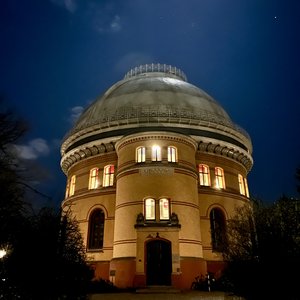
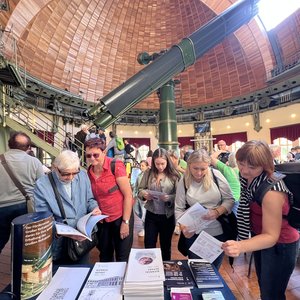
Das AIP lädt zum öffentlichen Beobachtungsabend im Großen Refraktor auf dem Telegrafenberg in Potsdam ein. Vorherige Anmeldung erforderlich, siehe Beobachtungsabende.
04.12.2025, 14:30 – 15:30
Wissenschaftliches

Speaker: Oscar Agertz (Lund Universtiy)
Title: Early Galactic Disks and Their Connections to Present-Day Galaxies

08.12.2025, 14:00 – 15:00
Wissenschaftliches

Speaker: Dr. Andrea Afruni (University of Florence)
Title: Studying the baryon cycle through observations, models and simulations

Das AIP lädt zu einer Spezialausgabe der Babelsberger Sternennacht auf dem Campus Babelsberg ein, einer interdisziplinären Veranstaltung zwischen Wissenschaft und Science-Fiction-Literatur. Mit dabei: die Wissenschaftlerin Dr. Ramona Augustin und der Science-Fiction-Autor Tobias Radloff.

15.01.2026, 14:30 – 15:30
Wissenschaftliches

Speaker: Sarah Pearson (NBI)
Title: TBD

28.01.2026, 19:00 – 20:00
Öffentliches

Das AIP lädt zum öffentlichen Beobachtungsabend im Großen Refraktor auf dem Telegrafenberg in Potsdam ein. Vorherige Anmeldung erforderlich, siehe Beobachtungsabende.
Öffentliches
Wissenschaftliches
Internes
Feiertage
Sonde vor der Sonne
6. Oktober 2025 – 9. Oktober 2025
PUNCH4NFDI-Logo_RGB
19. November 2025 – 20. November 2025
Banner XMM Newton SSC
17. März 2026 – 19. März 2026